Disabled Creators Don’t Just Need Representation; They Need Control – GADIM at ReelAbilities Industry Summit 2026 (Collab)
by Beth Haller | Originally Published May 25, 2026
This article is published in partnership with GADIM and The Global Disability News Network
“The best way to have basic disabled and neurodivergent people’s access needs met is to have disabled people involved with every part of media production. ”
— Beth Haller
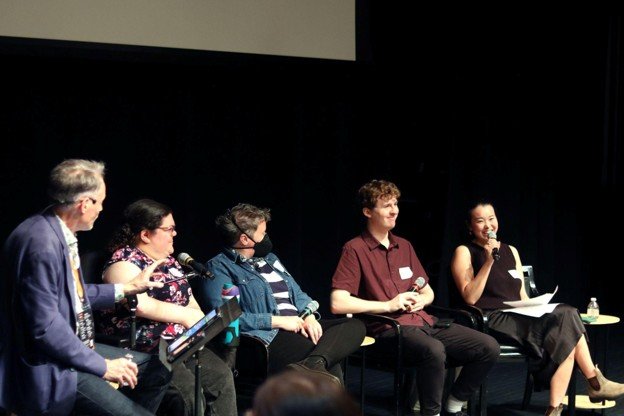
Image Description: Lawrence Carter-Long speaks with a panel of industry leaders about the latest data on inclusion and representation in entertainment. Pictured right to left: Rachel Neches (Center for an Urban Future). Drew English (Nielsen), Cassidy Dimon (FWD-Doc), Emily Ladau (Easterseals Southern California) and moderator, Lawrence Carter-Long (ReelAbilities)
We need to shift our focus from disability representation to supporting disabled media creators with accessible and inclusive media production at all levels. They know how to tell their stories the best.
Happily, the ReelAbilities Industry Summit in April 2026 brought attention to the work of disabled media creators by bringing together many of the current generation’s creators and stars of film, TV, internet, and theater, who give depth to the stories of actual disabled people. But the biggest theme of all speakers at the Industry Summit was the need of every kind of media production to be inclusive and accessible to the disabled community.
As a media and disability scholar, I have been researching how mass media represents the disabled or Deaf community since 1990.
As a Disability Studies and Media Studies professor, I began teaching about disability representation in the late 1990s, when I began my academic career. I never stopped writing about the topic because I am a former print newspaper journalist, blogger, and writer who quickly saw how each new media technology could impact disabled people getting their stories out.
As a disabled and neurodivergent person, I brought all of these parts of me as I listened virtually to the excellent panels at the ReelAbilities Industry Summit.
The summit was filled with panels of disabled people who are all part of the process to get actual disabled people into all aspects of media production. This is an important distinction from representation, because disabled people must have equal say in the creative process. For representation to improve, crew members, sound engineers, music composers, writers, cinematographers, directors, and producers, all who identify as disabled, must determine how media handle a disabled character or a disability issue.
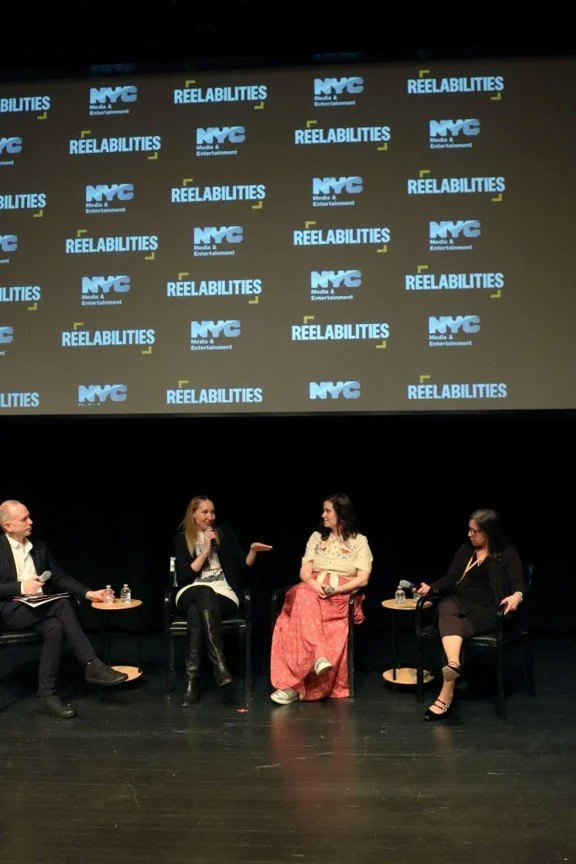
A panel of four speakers sits onstage during the ReelAbilities festival. A screen in the background displays the ReelAbilities and DOC NYC logos. From left to right, moderator, Isaac Zablocki (Reelabilities), Christie Marchese (Kinema), Kathy Susca (The Film Collaborative), and Kendra Hodgson (Women Make Movies).
Photo by: Emma Paton
I make that case in my 2023 book, Disabled People Transforming Media Culture for a More Inclusive World, that we need to focus on modern disabled media creators, who have been leveraging new media platforms and technologies for decades to recognize the lived experiences of people with disabilities and their authentic place in media and culture. These talented folks can instruct all of us about how to work toward inclusion of disabled people in all media industries.
Lawrence Carter-Long, Director of Engagement for ReelAbilities International, moderated a panel on disability inclusion in media industries, which explored what it will take to develop disabled filmmakers’ works, so they can get made and be seen by audiences.
Carter-Long said, “Inclusion, as I see it, is […] who tells the story, who shapes that story, who supports that story, who gets to access the process, who gets to see it, and who and what helps it travel.”
During the ReelAbilities Industry Summit, Lawrence Carter-Long speaks with a panel of industry leaders about the latest data on inclusion and representation in entertainment. Pictured right to left: Rachel Neches (Center for an Urban Future). Drew English (Nielsen), Cassidy Dimon (FWD-Doc), Emily Ladau (Easterseals Southern California) and moderator, Lawrence Carter-Long (ReelAbilities)
Photo by Emma Paton
On that panel was director and cinematographer Cameron Mitchell, the director of Disposable Humanity, which had itsNew York City premiere at the 2026 ReelAbilities Film Festival as the centerpiece feature film. Cameron is the son of groundbreaking Disability Studies scholars David Mitchell and Sharon Snyder. Cameron said he had been thinking about Disposable Humanity, which he considers his family’s documentary, since he was 9. Talking about disabled people’s places in history and culture was part of their family conversations. Because of that background and his parents’ presentation on American eugenics in Germany in the 1990s, Disposable Humanity is structured around his family’s unique questions as a family of disabled people. That’s important because nondisabled filmmakers would have asked different questions, he said. From a disability perspective, the feature-length documentary explores the horrors of the Nazi’s Aktion T4 murders of disabled Germans from 1939 to 1941.
Cameron said his parents’ Disability Studies work informed Disposable Humanity. They famously proposed their theory of narrative prosthesis in 2001, in which they illustrated how disability is used as a narrative device in literature and film. I used their concept in the first chapter of my 2023 book, “Collaborating on set to disrupt narrative prosthesis.” Within the narrative prosthesis framework, disabled characters are placed into the storylines of literature, film, and television to bolster negative themes of tragedy, villainy, inspiration, cure, etc. I argue that the only way to disrupt the inauthentic ableist metaphors in film and television will come from members of the disabled community being involved in all aspects of television and film productions.
Carter-Long said that media audiences need to see these stories that include the disabled community. “What I can tell you from a hundred years of cinema is,” he said, “that disability tends to be depicted in monochrome ways, black or white, tragic or heroic, violins or Rocky music. But most [disabled] people live somewhere in the messy middle. It’s those stories in the messy middle, with all their nuances and complications, that haven’t been told.”
As a society, “We’re conditioned to think of disability as something that happens to those people over there… We don’t want to face the inequities, we don’t want to face the lack of inaccessibility, we don’t want to face the discrimination […]”
Cameron Mitchell added that he has been stunned that few people who watch Disposable Humanity had heard of Aktion T4 “T4 should be to disabled people what the Shoah is to Jewish people.[…] Why aren’t we repeating and remembering these historical events? These are incredibly important to humanity, [and] as a part of our community.“
He wants people to pick up a book on Disability Studies because Americans “need a much deeper, much richer conversation about disability.” Cameron says the media industries will not change, so the disabled community needs to make things happen in the world of media themselves. “We need to be the change,” he said. “We need to be the people to realize we can’t rely on the tastemakers because they don’t have any taste,” which got a big audience laugh.
The bottom line is “we need to trust disabled auteurs to make the work,” Cameron said.
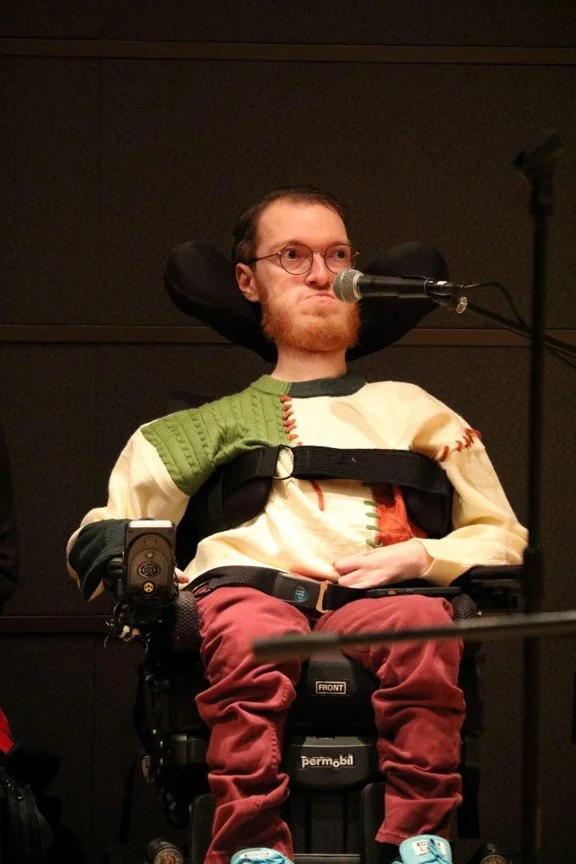
Serving on the judging panel of the Crip Script Pitch Competition, Stephen Verdile of Squeaky Wheel and NBCU. He is a white man with red hair and a beard, sits in a motorized wheelchair in front of a microphone. He has round glasses, a patchwork sweater and red pants.
Photo by Emma Paton
The ReelAbilities Industry Summit attendees also got to hear from longtime actor and writer Michael Patrick Thornton, who became disabled at age 24 from spinal strokes. Thornton, 47, said that as an actor, he has “tried to take roles where disability is not a plot point or something that needs to be solved. And my long-term bet has always been, if I can just stack up enough of those credits, it’ll hopefully change the game for the next generation.” And he has stacked up many roles for theater, film, and TV.
I have been following Thornton’s career since he joined the US ABC Network’s Private Practice as Dr. Gabriel Fife back in 2009, when I wrote about him on my Media dis&dat blog. I was pleased to see him on the TV show as a regular cast member. In 2010, his character began a romantic relationship with Audra McDonald’s Naomi character. It was complete with her fumbling for information about how a wheelchair user has sex by obtaining a hilarious educational pamphlet. Because so many disabled characters are not given sexual agency, it was significant that the characters of Thornton and McDonald were written as lovers, just as any nondisabled character would be.
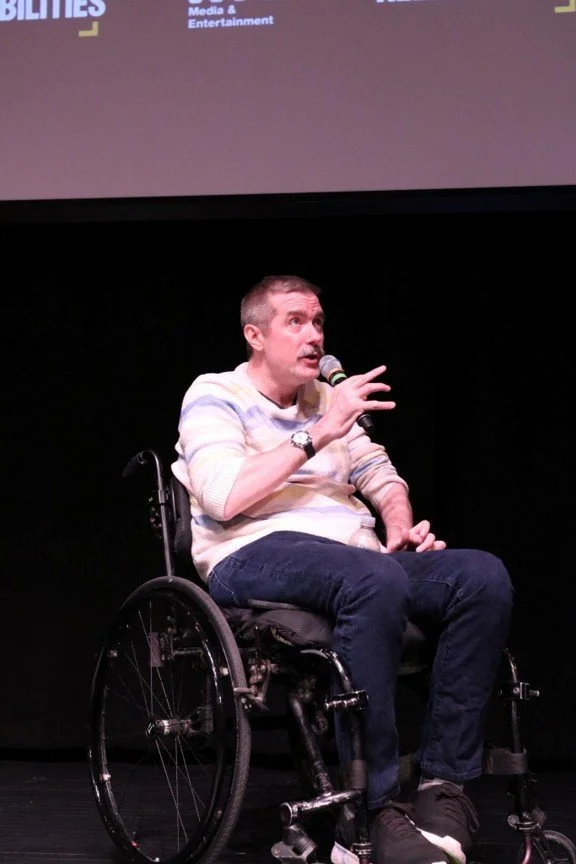
Award-winning actor, improviser, writer, and director Michael Patrick Thornton speaks to ReelAbilities Summit participants from the main stage. He is a white man with short, grey hair, a pale sweater and navy pants sits in his manual wheelchair, speaking into a microphone on a stage.
Photo by Emma Paton
Thornton recently starred in the Broadway revival of Waiting for Godot. In addition, he is playing independent-living pioneer Ed Roberts in the Apple biopic about US disability rights leader Judy Heumann called Being Heumann. He said, the film set was wonderfully accessible: “That was the first time in my life that I was ever in a makeup trailer because they had retrofitted it like a truck basically with like a huge lift on the back of it. And they were just getting us up and down, you know, and Apple went out of their way, I would say.”
An award-winning disabled actor working for almost three decades finally experiences an accessible makeup trailer in 2025?! We still have a long way to go to guarantee accessibility and inclusion on film and TV sets.
Thornton said it best: “I think what the powers that be need to do is have the courage to ask what we need and spend the fucking money to do it. I mean, these people’s companies have more money than God, you know, and you’re asking for basic access things.”
Well said. The best way to have basic disabled and neurodivergent people’s access needs met is to have disabled people involved with every part of media production. That’s the world I have been hoping for 35+ years.
About the Author:
Beth Haller — Beth Haller is co-director of GADIM, journalist, disability studies professor and also the person behind The Global Disability News Network.