Seeing Myself on Screen at the Seattle Deaf Film Festival (Collab)
by Rikki Poynter | Originally Published: June 8, 2026
This article is published in partnership with GADIM and The Global Disability News Network
“For the first time, I finally made it to the Seattle Deaf Film Festival—an event I’d hoped to attend for years.”
— Rikki Poynter
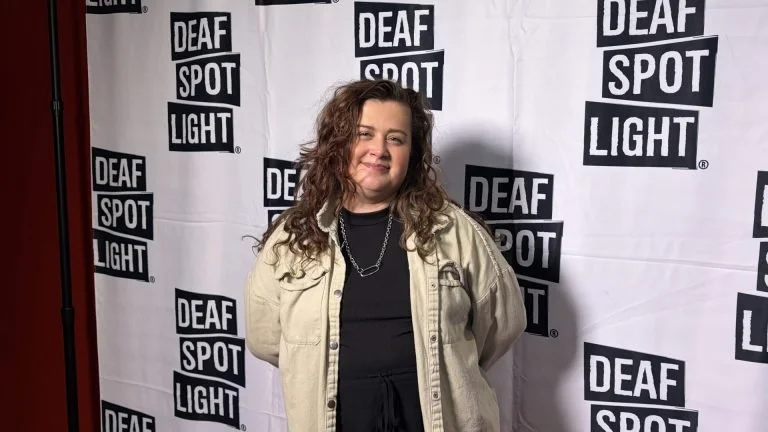
[Image Description: On the left, Rikki Poynter, a white woman with wavy, shoulder length brown hair, wears a tan jacket and black shirt. She stands in front of a banner that has the Deaf Spotlight logo, smiling]
What is the Seattle Deaf Film Festival?
The Seattle Deaf Film Festival (SDFF) is a biennial event in Seattle, WA. Run by Deaf Spotlight, it highlights Deaf culture through films, art, workshops, and camps.
This year’s SDFF featured 38 films from 12 countries: Australia, Brazil, Canada, France, Hong Kong, Ireland, the Netherlands, Norway, Spain, Sweden, the United Kingdom, and the United States. It was a hybrid event, with its in-person run lasting for three days, and afterward, all films were available for streaming for two weeks.
What kind of films were shown?
Films ranged from fiction to documentary, live-action to animation. The days were split into the following categories: family relationships, romantic relationships, autonomy and persistence, professional lives, and films that didn’t fit into any traditional category. Four features were also shown: Siren: The Voices of Shelley Beattie, OKTHANKSBYE, Loud Love, and Passengers.
Siren and Passengers stood out. Siren, a documentary about Shelley Beattie—a Deaf athlete exploring her identity — resonated with me. Growing up without the Deaf community or ASL, I related to Shelley.
Passengers, by my friend Dickie Hearts, is a romantic-comedy pilot expanding on a 2015 short. It follows Dale, a Deaf man moving to New York after a breakup, and his developing relationship with Wyatt, a hearing man new to Deaf culture and ASL.
Video Description: Short Youtube video from TGDNN of Rikki Poynter speaking about her experience at SDFF.
Why are Deaf film festivals so important?
Deaf film festivals are meaningful to me. Movies shape my life, and as a writer, they inspire my own work. Being with Deaf friends reignited my motivation to create.
Seeing myself properly represented on the big screen is rare in Hollywood. Most Deaf characters in mainstream films are created and cast by hearing people, leading to inauthentic mannerisms and sign language. For these actors, Deafness is often portrayed as just not being able to hear, when in reality it encompasses much more: a rich identity, history, and culture.
Deaf culture is celebrated here in many ways. It isn’t a monolith—Deaf culture in the US isn’t the same as in Hong Kong, just like cultures vary elsewhere. We learn from foreign films. Deaf people, like hearing people, are fascinated by different sign languages.
When Deaf people are in front of and behind the camera, authenticity is there. We don’t default or only cater to the typical tropes and stereotypes like Deaf people not being able to enjoy music, or sympathy for Deaf people navigating audism (discrimination against Deaf and hard-of-hearing people) in the hearing world. Yes, we do write about those things in our work, but we also write about the same mundane things that mainstream Hollywood does. Everyday romances. Family drama. One of the films was simply about someone really wanting to eat a ghost sandwich! When has Hollywood ever written about something as simple as that about Deaf people?
A Heartfelt Experience
Attending SDFF for the first time was exhilarating. Reconnecting with friends, discussing projects, and finding inspiration left me feeling hopeful and excited for the future of Deaf film.
This festival has been running for fourteen years, and I can’t wait to see what happens next.
Here’s to seeing you again in two years, SDFF!
Watch our interviews [on Youtube Shorts] from SDFF — all are in ASL with captions:
About the Author:
Rikki Poynter — Rikki Poynter is a Deaf content creator, writer, public speaker, accessibility consultant, and disability activist. Since 2015, she has worked relentlessly to bring awareness to disability rights and to make the world accessible online and offline, from entertainment spaces to political spaces. Her efforts have allowed her to be recognized by and work with the White House, Apple, Samsung, and Google. She is currently working to bring accessible information to candidates’ and politicians’ spaces, asking them to make campaigns accessible with ASL interpreters, captions, and more.